

Finding the right modular air-cooled chiller supplier is not just about comparing datasheets. If you are an HVAC contractor or procurement manager sourcing equipment for a commercial project in the Gulf, you need a commercial cooling manufacturer who can deliver units that hold their rated COP at 46 degrees C ambient, not just at the standard 35 degrees C test point printed in the catalog. This guide covers what separates a credible air-cooled chiller systems provider from an assembly shop, and how to write an RFQ that gets you comparable technical proposals instead of discount offers.
Why a modular air-cooled chiller supplier matters in arid, high-ambient regions
How your modular HVAC chiller supplier solves the water consumption problem
A water-cooled centrifugal chiller in Dubai can consume 3 to 5 cubic meters of makeup water per 1,000 kW of cooling capacity every hour. For a 5,000 kW commercial building, that comes to 15 to 25 cubic meters per hour at peak load. Multiply that across a 10-hour cooling day in August and the number quickly leaves the “miscellaneous” column on the MEP schedule. According to ASHRAE Technical Committee 8.6 data on cooling tower water use in hot-dry climates, annual makeup water consumption for a water-cooled plant in the Gulf routinely exceeds 8,000 cubic meters per year for a mid-rise office building.
Every modular air-cooled chiller supplier solves this by eliminating the cooling tower entirely. Heat rejection happens directly to ambient air through fin-and-tube condensers. No cooling tower,No condenser water pumps,No chemical dosing skids. For anyone who also manages the O and M budget alongside procurement, that means fewer subcontractors, fewer consumables, and zero makeup water line items.
The tradeoff is compressor power draw. At 48 degrees C ambient, an air-cooled screw chiller module might pull 15 to 20 percent more kW per ton than an equivalent water-cooled machine at 32 degrees C condensing water. Whether that gap sinks your operating budget depends on the local electricity tariff and who is paying it.
Why modular air-cooled chiller systems cut installation and redundancy risk
A modular air-cooled chiller plant splits capacity across multiple independent modules. If a 1,200 kW project uses four 300 kW modules, a single compressor failure takes out 25 percent of capacity, not 100 percent. You can also phase the installation: order and commission two modules for initial occupancy, then add the other two when the tenant buildout finishes. For a commercial cooling manufacturer building to spec rather than selling off the shelf, this phased approach fits into project cash flow planning.
For sites with tight crane access or narrow approach roads, modular units solve logistics. A single 40-foot chiller frame can weigh 12 tonnes and need a 200-tonne mobile crane. Four 300 kW modules can each ship in a standard open-top container and lift into place with a smaller mobile crane or a telehandler. The difference lands directly on the mechanical contractor’s installation bid.
What a qualified modular air-cooled chiller supplier should prove at design ambient
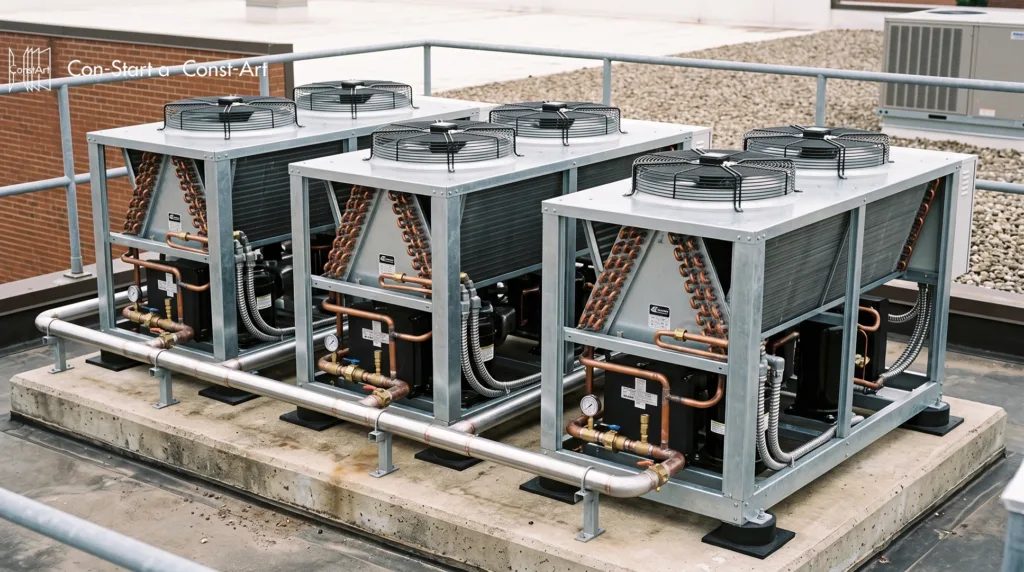
COP and IPLV: ask your air-cooled chiller supplier for part-load data, not just full-load ratings
Most chiller datasheets show Eurovent-certified COP at ARI standard conditions: 35 degrees C ambient, 7 degrees C leaving chilled water. That number lets you compare models in a catalog. It says nothing about how the module runs in Riyadh in July. The AHRI Standard 550/590 rating conditions are deliberately temperate, and any experienced procurement manager knows to request site-specific part-load data.
Ask every supplier for three numbers:
- COP at 46 degrees C ambient, 7 degrees C leaving chilled water, 100 percent load
- IPLV calculated with the AHRI or EN 14825 weighting curve, but using your local bin temperature data instead of the default temperate-climate bins
- Minimum stable part-load ratio as a percentage of full capacity
Commercial buildings run at 50 to 70 percent load for more than 80 percent of their annual operating hours. A modular HVAC chiller with a strong full-load COP but weak part-load efficiency can cost more in electricity over a year than a unit with a slightly lower rated COP whose efficiency curve stays flat across the part-load range.
If a modular air-cooled chiller supplier cannot provide part-load data at your design ambient temperature, that gap is not trivial. Either they have not tested the unit in your operating conditions, or they have and do not want you to see the numbers.
Compressor type and refrigerant: what your commercial cooling manufacturer should certify
Scroll compressors dominate modular air-cooled chiller systems up to roughly 150 kW per module. Beyond that, screw compressors become standard. Both architectures work. The procurement question is which refrigerant the supplier has qualified on the module and whether that refrigerant will remain available over a 15 to 20 year service life.
R-134a faces global phase-down under the Kigali Amendment. R-410A is under similar pressure across multiple jurisdictions. R-32 and R-454B are the current frontrunners for new equipment in markets aligned with EU F-gas regulation timelines. Even if your project country has no domestic phase-down schedule, refrigerants affordable today may become restricted or expensive within the asset’s lifetime.
Ask for the manufacturer’s declared GWP of the refrigerant used in the quoted model, not the theoretical GWP of the pure fluid. Total system charge and expected annual leak rate both matter for compliance reporting.
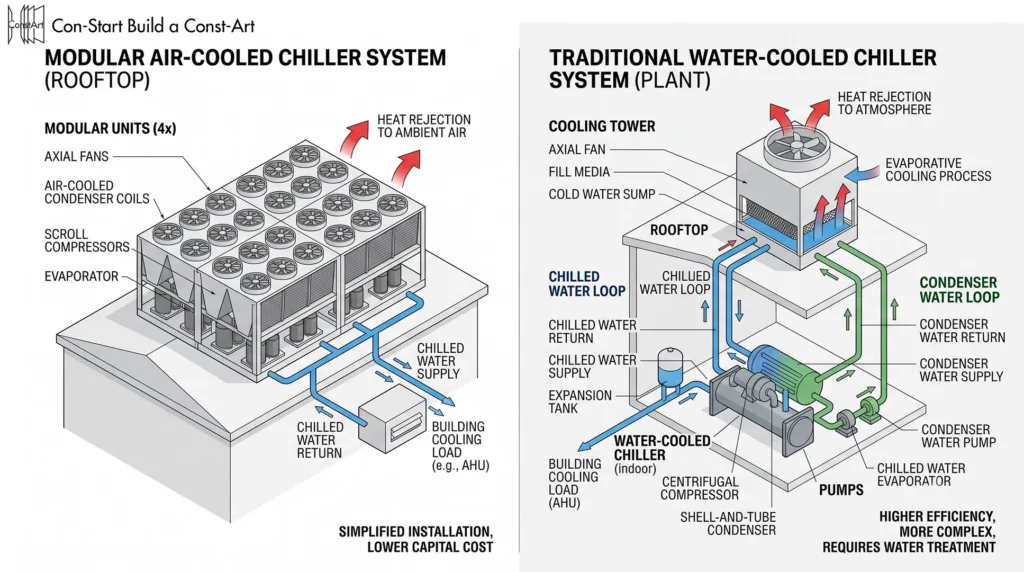
Air-cooled vs water-cooled chillers in arid regions: what the numbers say
The table below compares the two approaches on criteria that matter in arid, high-ambient climates. These figures assume a commercial office building with 2,000 kW installed cooling capacity in a Gulf-region city.
| Criterion | Modular Air-Cooled Chiller | Water-Cooled Centrifugal/Screw Chiller |
|---|---|---|
| Makeup water consumption | None | 30 to 50 m³/day at peak (6,000 to 10,000 m³/year) |
| Installed cost per kW (equipment only) | $280 to $420 | $220 to $340 |
| Total installed cost per kW (incl. cooling tower, pumps, piping, chemical treatment) | $320 to $480 | $450 to $700 |
| Full-load kW/ton at 46°C ambient | 1.35 to 1.60 | 0.75 to 0.95 (at 32°C condenser water) |
| Annual energy cost (Gulf electricity tariff, ~$0.08/kWh) | Higher by 15 to 30 percent | Lower, but water cost offsets part of the gap |
| Maintenance complexity | Low: condenser coil cleaning, fan motor replacement | Moderate to high: cooling tower cleaning, water treatment, tube brushing |
| Partial failure risk | Contained to one module | Entire plant offline if single compressor fails |
| Space requirement | Larger footprint at grade or on roof | Smaller mechanical room footprint, plus cooling tower yard |
| Regulatory risk (water use restrictions) | Minimal | High in regions with groundwater depletion or desalination dependency |
For Gulf procurement, the total installed cost column often understates the advantage of air-cooled chiller systems. Most water-cooled plant budgets I have reviewed include the cooling tower, condenser pumps, and chemical dosing skid, but miss the ongoing water treatment chemical procurement, the tower basin cleaning contract, and the replacement cost of fill media every 5 to 7 years. An air-cooled plant has none of these costs.
How to qualify a modular air-cooled chiller supplier: OEM, ODM, and factory evidence
Three tiers of modular HVAC chiller manufacturers
The modular air-cooled chiller market sorts into three tiers. Tier one is the multinationals: Carrier, Trane, Daikin, and their regional joint ventures. Standard catalog models with limited customization and pricing that carries brand and distribution overhead.
Tier two is independent manufacturers with in-house engineering and production lines. These suppliers offer OEM and ODM arrangements: they build chillers to your specification with your choice of compressor brand, controls platform, and coil metallurgy, branded under their name or yours. For procurement managers importing containers of air-cooled chiller systems into a project market, a tier two supplier delivers custom manufacturing at a lower ex-works price than a tier one catalog unit.
Tier three is assembly shops that buy components off the shelf and bolt them onto a frame. Attractive pricing, but engineering support, testing documentation, and after-sales parts availability vary from order to order. If a modular air-cooled chiller supplier cannot give you a detailed test report for each unit before shipment, or cannot name the compressor make and model before you place a deposit, you are not working with a manufacturer. You are dealing with a reseller.
Questions to ask during supplier qualification:
- Do you have a dedicated chiller test bench with a calibrated calorimeter, or do you outsource performance testing?
- Can you provide a factory witness test, in person or by live video, before each unit ships from your production line?
- What compressor brands do you stock and qualify on your standard chassis?
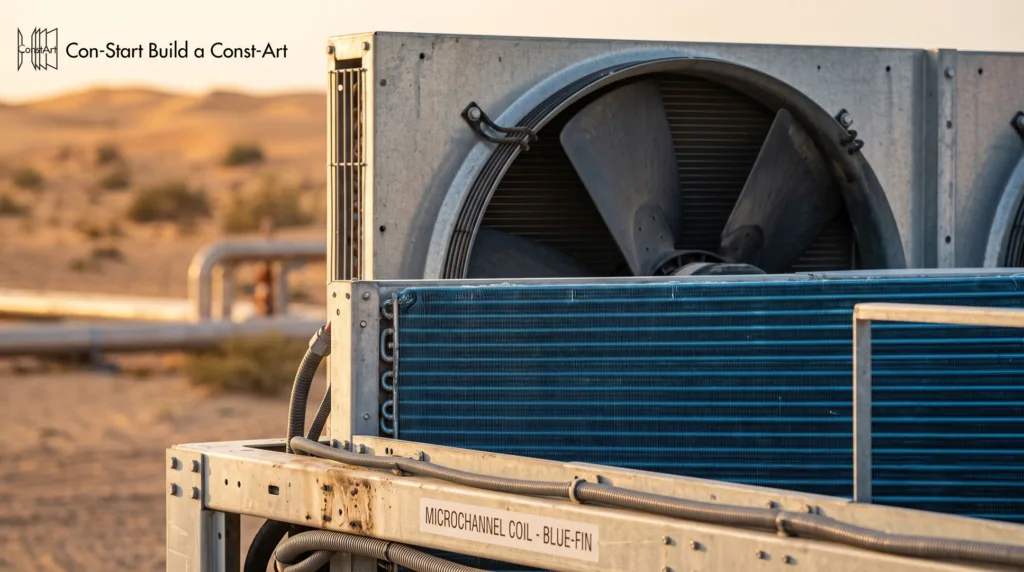
- Can you supply modules with microchannel condenser coils for corrosive coastal environments, or Cu/Al fin-and-tube only?
- What is your standard warranty on the compressor, the heat exchangers, and the complete unit?
If the answers to the first three questions are vague, you are talking to a trader.
Certifications, testing, and third-party validation
For import into most Middle Eastern markets, the baseline requirement is a CE mark or equivalent third-party certification confirming compliance with the Machinery Directive, Low Voltage Directive, and EMC Directive. Most project specifications also require ISO 9001 for the manufacturer’s quality management system.
Beyond the minimum, look for:
- Eurovent or AHRI performance certification on the exact model and capacity quoted, not a “similar” unit
- Pressure Equipment Directive (PED) compliance for the condenser and evaporator vessels, with the correct fluid group and category stamped on the nameplate
- ISO 16813 or equivalent factory sound test data if the modules will sit on a rooftop near residential buildings
A modular air-cooled chiller supplier who can show the Eurovent or AHRI certificate for the actual model on your order, not a variant from three years ago, has done the engineering work. That matters more than a brochure.
Total cost of ownership: what separates a capable modular air-cooled chiller supplier
A chiller that costs $60,000 ex-works but burns $15,000 more in electricity every year than a $72,000 alternative pays back the price difference in under a year of operation. Most commercial owners keep chillers in service for 15 years or longer. Electricity, maintenance labor, spare parts, and refrigerant top-ups dwarf the initial purchase price over that period.
The biggest procurement mistake I see is evaluating bids on ex-works equipment price alone. A proper TCO comparison for modular air-cooled chiller systems in a Gulf climate should cover:
- Annual electricity cost, modeled with local bin temperature data and the actual building load profile
- Estimated annual maintenance: condenser coil cleaning frequency (depends on local dust conditions), compressor oil changes, controls firmware updates
- Compressor replacement probability and cost at 10 and 15 year horizons
- Refrigerant cost escalation risk over the equipment lifetime
- Spare parts lead time from the supplier’s nearest warehouse to the project site
A modular air-cooled chiller supplier who can produce a credible TCO model with assumptions you can verify understands the difference between selling a machine and supporting an asset for two decades.
Request a Quote
If you are sourcing modular air-cooled chillers for an upcoming commercial project in the Middle East, North Africa, or any high-ambient region, send us your project requirements and we will respond within 24 hours.
We manufacture modular air-cooled scroll and screw chillers from 30 kW to 1,500 kW per module, with ISO 9001 certified production and full-load factory testing on every unit before crating. Our engineering team supports OEM and ODM builds with your choice of compressor brand, coil coating, and controls platform.
To receive a quotation, include the following in your RFQ:
- Total cooling capacity required (kW or tons)
- Design ambient dry-bulb temperature
- Leaving chilled water temperature and delta-T
- Supply voltage and frequency available on site
- Any refrigerant preference or restriction
- Target delivery window
Reach our sales engineering team at info@constart.net or fill out the RFQ form below,You can contact us now by click here.We aim to return a complete technical proposal, including part-load performance data at your design conditions, within three working days.


