
Introduction
In the world of commercial HVAC design, meticulous attention is paid to chillers, air handling units, and ductwork. However, the final point of air delivery—the air diffuser—is a component that can make or break a system’s performance. The effective selection and placement of air diffusers HVAC systems rely on are paramount to achieving optimal thermal comfort, energy efficiency, and indoor air quality (IAQ). A poorly chosen diffuser can lead to drafts, temperature stratification, and unwanted noise, compromising an otherwise well-designed system. This guide is crafted for HVAC engineers, contractors, and project managers, providing a deep dive into the critical role of air diffusers HVAC components, exploring the most common types, and outlining the key criteria for successful application in modern building projects.
What Are Air Diffusers in HVAC Systems?
At its core, an air diffuser is the terminal device in an HVAC ductwork system responsible for distributing conditioned air into a specific space. While often used interchangeably with grilles or registers, a diffuser performs a more complex function. Its primary purpose is to discharge supply air in a specific pattern and at a controlled velocity, promoting thorough mixing with the ambient room air. This process, known as air induction, is critical for achieving temperature uniformity and occupant comfort.

Effective HVAC air distribution hinges on several key aerodynamic principles managed by the diffuser:
- Throw: The horizontal or vertical distance an airstream travels from the diffuser face before its velocity slows to a specified terminal level (e.g., 50 feet per minute).
- Drop: The vertical distance the lower edge of a horizontally projected cooled airstream falls due to its higher density compared to the warmer room air.
- Spread: The divergence of the airstream as it leaves the diffuser.
- Coandă Effect: This is the tendency of a fluid jet (in this case, air) to stay attached to a nearby surface. Diffusers, particularly ceiling-mounted types, leverage the Coandă effect by “sticking” the conditioned air to the ceiling, allowing it to travel further and mix more gradually before dropping into the occupied zone, thus preventing uncomfortable drafts.
A well-selected air diffuser ensures that these factors work in harmony to meet the design goals for airflow (CFM), noise criteria (NC), and space air diffusion performance index (ADPI). Ultimately, the seemingly simple diffuser is a sophisticated engineering component that dictates the success of the entire air distribution network.
Common Types of Air Diffusers
The market offers a wide variety of air diffusers HVAC professionals can choose from, each with unique performance characteristics tailored to different applications. Understanding the distinctions between them is the first step toward making an informed selection.
1.Square Ceiling Diffuser
The square ceiling diffuser is arguably the most ubiquitous air terminal device in commercial buildings. Its versatility, cost-effectiveness, and compatibility with standard suspended T-bar ceiling grids have made it a staple in offices, retail spaces, schools, and healthcare facilities.

Design and Airflow: A typical square ceiling diffuser features a stamped or fabricated face with a multi-louvered core. This core is engineered to direct air in one, two, three, or, most commonly, four directions. The 4-way blow pattern provides a 360-degree radial diffusion, making it exceptionally effective for conditioning the core of a large, open-plan space. The design capitalizes on the Coandă effect, spreading the air across the ceiling surface for extensive coverage and gentle mixing.
Applications and Benefits:
- General Office Spaces: Its broad, even coverage is ideal for modular workstations and open-plan layouts where flexibility is key.
- Retail Stores: A square ceiling diffuser provides consistent comfort for customers and staff across wide floor areas.
- Classrooms: Helps maintain a uniform temperature, which is crucial for a comfortable learning environment.
Key Advantages:
- Cost-Effective: They are among the most economical diffuser options, making them suitable for projects with tight budgets.
- Versatility: Available in multiple blow patterns to accommodate room layouts and perimeters.
- Easy Installation: Designed to fit seamlessly into standard 24″x24″ or 12″x12″ ceiling grids, reducing labor time.
- Good Performance: Offers a solid balance of throw, induction, and low pressure drop for most standard applications.
For reliable performance in a vast range of commercial settings, the square ceiling diffuser remains a go-to choice for many HVAC engineers.
2.Round HVAC Diffuser
The round HVAC diffuser excels in air mixing and offers a distinct aesthetic appeal, characterized by its concentric, stepped cones. Manufacturers engineer this diffuser type for high-performance air distribution, particularly in challenging environments.

Design and Airflow: The design of a round HVAC diffuser creates a 360-degree radial airflow pattern with high induction. High induction means the diffuser causes a large amount of room air to be drawn into and mixed with the primary supply airstream. This rapid mixing quickly equalizes the temperature difference between the supply and room air, effectively minimizing drafts and temperature stratification, even with large temperature differentials (ΔT). The airflow pattern can often be adjusted from a horizontal projection (for cooling) to a vertical projection (for heating) in some models.
Applications and Benefits:
- High-Ceiling Spaces: Their strong projection and mixing capabilities make them ideal for atriums, warehouses, airport terminals, and convention centers.
- Variable Air Volume (VAV) Systems: A round HVAC diffuser maintains a stable airflow pattern even at reduced airflow rates (turndown), which is a common challenge for other diffuser types.
- Architecturally Sensitive Designs: Architects often prefer the clean, symmetrical appearance for modern and industrial aesthetics.
Key Advantages:
- Superior Air Mixing: The high induction rate provides excellent thermal comfort and eliminates hot or cold spots.
- Reduced Stratification: Highly effective at destratifying air in high-ceiling heating applications, pushing warm air back down into the occupied zone.
- VAV Compatibility: Maintains performance and comfort across a wide range of air volumes.
- Aesthetic Appeal: Offers a visually striking alternative to standard square diffusers.
When performance is paramount, especially in spaces with high ceilings or significant cooling loads, the round HVAC diffuser is a technically superior solution.
3.Linear Slot Diffuser
The linear slot diffuser provides a clean, minimalist aesthetic while offering highly flexible and precise HVAC air distribution. As the name suggests, it consists of one or more long, narrow openings (slots) and integrates seamlessly into ceilings or high on sidewalls.
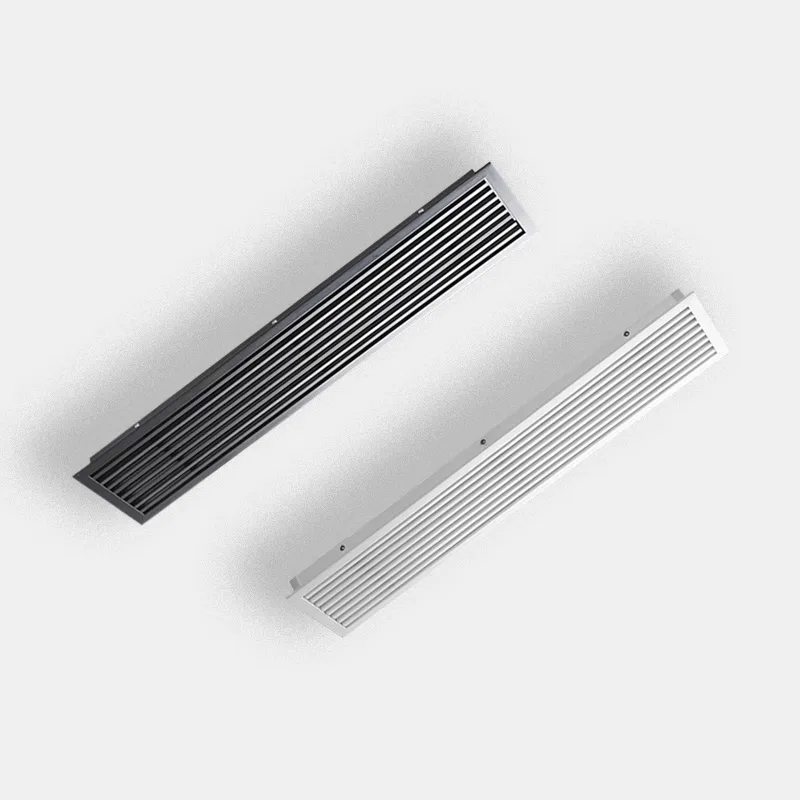
Design and Airflow: Linear slot diffusers feature internal pattern controllers that allow the discharge direction of the air to be adjusted. This enables the creation of a tight “curtain” of air, a vertical projection, or a horizontal spread across the ceiling. They can be installed as single units or joined together for continuous runs of any length.
Applications and Benefits:
- Perimeter Zones: Excellent for installation along window walls to create an air curtain, offsetting heat gain or loss.
- Modern Architectural Spaces: Architects and designers favor their unobtrusive design in high-end offices, museums, hotel lobbies, and conference rooms where aesthetics are critical.
- Variable Airflow: Many models are well-suited for VAV applications, maintaining stable performance.
Key Advantages:
- Architectural Integration: Blends seamlessly with interior design, often becoming virtually invisible.
- Flexible Air Pattern: The direction of airflow can be easily adjusted on-site to suit the specific needs of the space.
- Continuous Lengths: Can be installed in long, uninterrupted runs for uniform air distribution along an entire wall or zone.
4.Swirl Diffuser
The swirl diffuser is a high-performance air terminal engineered to generate a swirling, helical discharge pattern. Fixed or adjustable radial blades achieve this by imparting a rotational motion to the supply air.

Design and Airflow: The defining characteristic of a swirl diffuser is the intense, high-induction mixing it creates. The swirling airflow pattern entrains a significant amount of room air very close to the diffuser face. This results in a very rapid decay of air velocity and temperature differential, allowing large volumes of air to be introduced into a space without creating drafts.
Applications and Benefits:
- High Air Change Environments: Ideal for laboratories, data centers, kitchens, and other spaces requiring high air change rates (ACH).
- Spaces with High Cooling Loads: Their ability to handle large ΔT makes them perfect for rooms with significant heat sources.
- High Ceilings: Like the round HVAC diffuser, the swirl diffuser is highly effective in large-volume spaces, ensuring conditioned air reaches the occupied zone.
Key Advantages:
- Maximum Thermal Comfort: The high induction provides exceptional air mixing and prevents drafts, even with high airflow volumes.
- Handles Large ΔT: Can effectively distribute supply air that is significantly colder than the room air without “dumping.”
- Reduced Stratification: The swirling motion is very effective at breaking up stratified layers of air.
How to Choose the Right Air Diffuser for Your Project
Selecting the correct air diffusers HVAC systems need is a multi-faceted decision that goes beyond simple aesthetics. A systematic approach ensures all performance criteria are met.
Key Selection Criteria:
- Ceiling Height and Room Geometry: For standard ceilings (8-10 ft), a square ceiling diffuser is often sufficient. For heights above 12 ft, a round HVAC diffuser or swirl diffuser should be considered to ensure the air has enough throw to reach the occupied zone without causing drafts.
- Airflow Requirements (CFM): Each diffuser has a specified operating range for airflow. Selecting a diffuser that is too small for the required CFM will result in excessive noise and pressure drop. Conversely, one that is too large will lead to poor throw and air dumping. Always consult manufacturer performance data.
- Noise Criteria (NC): The noise generated by air passing through a diffuser is a critical factor in spaces like offices, libraries, and conference rooms. The target NC rating for the space must be a primary consideration. Swirl and round diffusers often offer better acoustic performance at higher airflows.
- Application (Heating vs. Cooling): While most diffusers handle cooling well, heating high-ceiling spaces can be challenging. Round and swirl diffusers with adjustable patterns are often superior for pushing warm air downwards.
- System Type (Constant vs. Variable Volume): For VAV systems, it is essential to choose a diffuser that maintains a stable and comfortable air pattern at lower flow rates. The round HVAC diffuser and certain linear slot diffusers are particularly well-suited for VAV turndown.
- Architectural Aesthetics: The diffuser should complement the interior design. While performance should never be sacrificed for looks, options like the linear slot diffuser offer excellent integration possibilities.
Standards and Best Practices
Adherence to industry standards is non-negotiable for ensuring the safety, comfort, and efficiency of an HVAC system. Proper diffuser selection is integral to meeting these benchmarks.
- ASHRAE (American Society of Heating, Refrigerating and Air-Conditioning Engineers): Two key standards are heavily influenced by air distribution:
- ASHRAE Standard 55 – Thermal Environmental Conditions for Human Occupancy: This standard defines the range of indoor thermal conditions acceptable to a majority of occupants. Proper diffuser selection is critical to controlling air speed and temperature distribution to meet these requirements.
- ASHRAE Standard 62.1 – Ventilation for Acceptable Indoor Air Quality: This standard dictates minimum ventilation rates. The HVAC air distribution system must effectively deliver this fresh air to the breathing zone, a task directly managed by the diffusers.
- SMACNA (Sheet Metal and Air Conditioning Contractors’ National Association): SMACNA provides standards for duct construction and installation. A properly installed duct system, free of leaks and with smooth transitions leading to the diffuser, is essential for achieving the cataloged performance data of the selected air diffusers HVAC components.
Common Mistakes in Air Diffuser Selection
Even experienced professionals can make missteps. Avoiding these common errors can significantly improve system performance and client satisfaction.
- Ignoring the Coandă Effect: Placing a ceiling diffuser on a surface that is too small or mounting it on a drop-down duct (free-hanging) can negate the Coandă effect. This causes the cold, dense supply air to “dump” directly downwards, creating significant drafts.
- Poor Placement and “Short-Circuiting”: Installing diffusers too close to return air grilles draws the supply air directly back into the return ductwork before it has a chance to condition the space.This “short-circuiting” drastically reduces system efficiency.
- Mismatching Diffuser to Air Volume: A common mistake is selecting a diffuser based on duct size rather than the required CFM and throw data. This often leads to noisy operation or poor room air motion.
- Selecting Based on Aesthetics Alone: Prioritizing an architectural look without verifying that the chosen diffuser’s performance characteristics (throw, spread, NC rating) are suitable for the application is a recipe for an uncomfortable indoor environment.
Conclusion
The selection of air diffusers HVAC professionals make is a critical decision .That directly impacts the final performance and success of any commercial HVAC project. It is far more than a finishing touch; it is the lynchpin of effective HVAC air distribution. By understanding the distinct characteristics of each type, Which from the workhorse square ceiling diffuser to the high-performance round HVAC diffuser, linear slot, and swirl diffusers—engineers and contractors can design systems that deliver unparalleled thermal comfort, operate efficiently, and meet the highest standards of indoor environmental quality. A thoughtful and data-driven approach to diffuser selection ensures that the conditioned air produced by the system is delivered exactly where&how it’s needed.
For expert guidance ,on selecting the ideal air diffusers for your next commercial project, or to inquire about our bulk pricing and technical specifications, contact our engineering team today.


